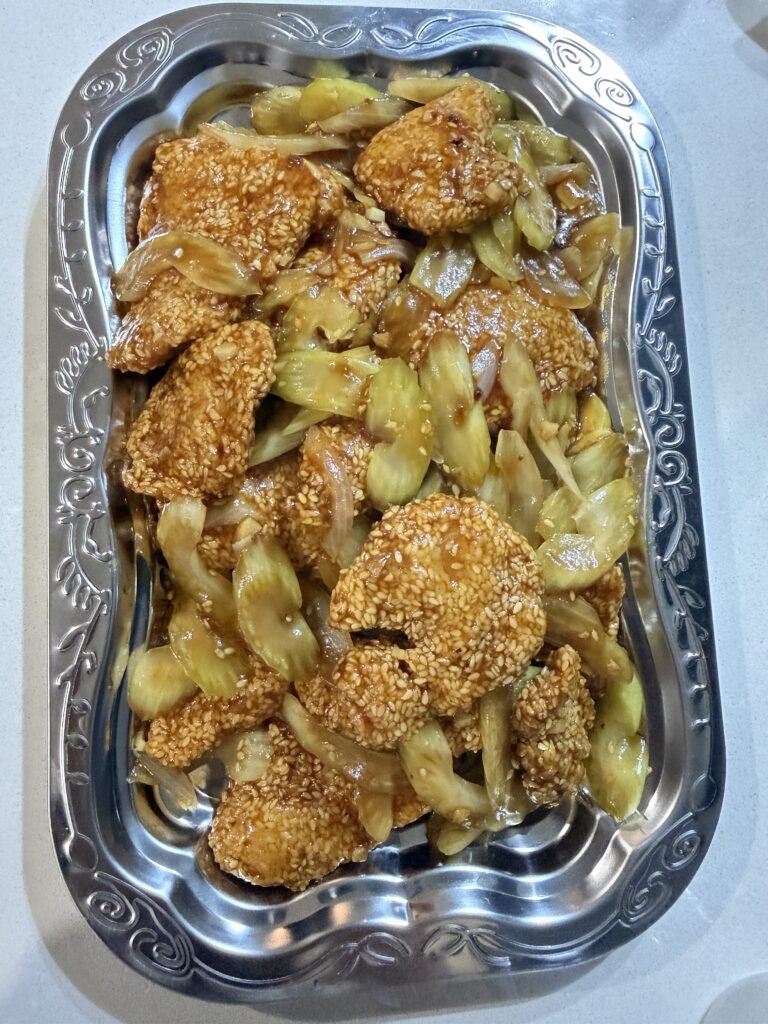
I only had one photo.
This sesame chicken is from a restaurant in Suva that closed years ago. The chef moved to a tiny hole-in-the-wall spot, and as far as I know it’s the only place in all of Fiji that still makes it like this.
It’s not the sticky takeaway kind. The chicken is coated in sesame seeds and fried first; crisp and nutty, before being folded through a soy-based gravy with onion, garlic and celery. Every time I go home, I order it.
This time I came back with nothing but the memory. I couldn’t find a recipe anywhere that came close. So I rebuilt it from taste.
It’s not exact. But it’s 90% there. And 90% was enough to take me back.
What makes this different from takeaway sesame chicken?
Most sesame chicken recipes you’ll find online are the American-Chinese takeaway version, deep fried battered pieces coated in a sweet, sticky, slightly fluorescent sauce. That’s a perfectly good dish. It’s just not this one.
The Fijian-Chinese version I’m chasing is drier, savourer, and more restrained in sweetness. The sesame is structural, pressed into the chicken before frying so it becomes part of the crust rather than something stirred through a sauce. The gravy is there to coat, not to drown. And the celery isn’t decoration. It belongs.
This is a dish shaped by Fiji’s Chinese community, a flavour profile that’s distinctly its own. It doesn’t travel well in recipe databases because it’s not the dominant version. Which is exactly why I had to rebuild it myself.
On the ingredients
Chicken breast and bicarb soda Using breast here is intentional — the original was sliced breast, not thigh, and the texture matters. The bicarb soda is doing the work of velveting: it raises the pH of the meat slightly, which breaks down proteins and keeps the chicken tender through frying. You only need 1/2 a teaspoon. More and you’ll taste it.
White sesame seeds White, not black. Black sesame has a slightly more bitter, earthy flavour that would change the dish. White sesame is nuttier and milder — it coats evenly and toasts gold in the oil. Press the chicken pieces firmly and deliberately into the seeds before frying. A light roll won’t hold. You want genuine pressure so the seeds embed into the cornflour coating rather than sitting on top of it.
Two soy sauces Regular soy sauce is your salt and umami base. Dark soy sauce is there for depth and colour — it’s thicker, slightly sweeter, and gives the gravy that dark glossy finish. Don’t substitute one for the other and don’t skip the dark soy. The sauce will look flat without it.
Oyster sauce This is what bridges the savoury and the slightly sweet. It adds body to the gravy in a way that soy alone can’t. If you’re cooking for someone avoiding shellfish, a mushroom-based oyster sauce is a reasonable substitute and reads similarly in the final dish.
Celery This is the ingredient people are most likely to question. Don’t omit it. It provides a clean, slightly bitter crunch that cuts through the richness of the fried chicken and the sauce. It also just happens to be what was in the original. Cook it briefly, two minutes in the pan so it retains some texture. You’re not trying to soften it into the background.
Cornflour, twice Cornflour appears in the coating and again in the sauce. In the coating it creates the base for the sesame to adhere to and gives the fried pieces their slight crispness. In the sauce, mix it with the stock and other liquids before adding to the pan — this prevents lumping and gives you control over the thickness. Add a little, simmer, assess. You want the sauce to cling to the chicken, not pool at the bottom of the bowl.
Tips before you start
Rest the coated chicken before frying. The 15-minute rest after coating isn’t just for the velveting to work, it also gives the cornflour time to hydrate slightly so it adheres better and fries more evenly.
Don’t overcrowd the pan. Fry in batches. Overcrowding drops the oil temperature and steams the chicken rather than frying it. You’ll lose the crust and with it the whole point of the dish.
Medium heat, not high. Sesame seeds burn quickly. Medium heat gives you a golden crust on the chicken and toasted seeds without scorching. If the seeds are darkening too fast before the chicken is cooked through, reduce the heat.
Mix your sauce before it hits the pan. Combine stock, both soy sauces, oyster sauce, sesame oil, sugar and cornflour in a jug before you start cooking the aromatics. Having it ready means you can move quickly once the garlic is fragrant — garlic waits for no one.
Chicken thighs work if you prefer them. Thigh is more forgiving of heat and slightly richer. The texture of the finished dish will be softer and less defined. It’s good but it’s a different dish — closer to a braise with sesame than the crisp-edged version I’m going for here.
To make gluten-free: Swap the regular soy sauce for tamari, use a certified GF oyster sauce, and check your cornflour packaging. The dish otherwise adapts well.
FAQ
Can I make this ahead of time? You can prep the chicken (coated, resting in the fridge) and mix the sauce the day before. But fry and assemble right before serving. Once the sesame chicken is folded through the sauce it needs to be eaten. Leftovers reheat reasonably well in a pan with a splash of stock, but the sesame coating will be softer.
Is this an authentic Fijian-Chinese recipe? It’s a reconstruction. The dish is real — it’s from a specific restaurant in Suva that I’ve been eating at for years — but this recipe was rebuilt from taste memory and one photograph, not from a family recipe or the original chef’s method. What I can say is that it tastes like what I remember, which is the only measure I had available to me.
What does the celery do — can I leave it out? The celery provides crunch and a mild bitterness that balances the richness of the fried chicken and the soy-based sauce. You can leave it out but the dish becomes sweeter and heavier without it. I wouldn’t.
Why is my sesame coating falling off during frying? Most likely the chicken wasn’t pressed firmly enough into the seeds, or the oil wasn’t at temperature before the chicken went in. Make sure you press each piece deliberately and check the oil is hot before the first batch goes in. A drop of water should spit on contact.
Can I use pre-toasted sesame seeds? You can, but they’ll toast further in the oil anyway. Raw white sesame seeds work fine and will reach the right colour during frying. No need to toast them separately first.
Sesame Chicken
Ingredients
For the chicken
- 2 chicken breasts sliced slightly thicker than you would for a stir-fry
- 1/2 tsp bicarb soda
- Salt to taste
- 1 tsp sesame oil
- 1 egg lightly beaten
- 2 tbsp cornflour
- White sesame seeds for coating
- Oil for frying
For the sauce
- 3 cloves garlic minced
- 1 onion chopped
- 2 stalks celery chopped
- 1 cup chicken stock
- Soy sauce to taste
- 1 tsp dark soy sauce
- 1 tbsp oyster sauce
- 1 tsp sesame oil
- 2 tsp sugar
- Cornflour to thicken
Instructions
- Combine chicken with bicarb, salt, sesame oil and egg. Add cornflour and mix until evenly coated. Rest for 15 minutes.
- Press each piece firmly into sesame seeds to coat.
- Fry in oil over medium heat until golden and cooked through. Set aside.
- In the same pan, sauté garlic until fragrant. Add onion and celery and cook for 2 minutes.
- Mix stock, both soy sauces, oyster sauce, sesame oil, sugar and a little cornflour together, then pour into the pan. Simmer until thickened.
- Add chicken back in and toss for one minute until well coated.
- Serve immediately over steamed jasmine rice with a side of steamed greens. This dish doesn't hold. The sesame crust softens as it sits, so bring it to the table the moment it's done.